- Plantas
- ›Plantas vasculares
- ›Plantas con flores
- ›Magnolias, margaritas y parientes (dicotiledóneas)
- ›Cactos, amarantos, claveles y parientes
- ›Amarantos, espinacas, betabeles y parientes
- ›Camphorosmoideae
- ›Camphorosmeae
- ›Enchylaena
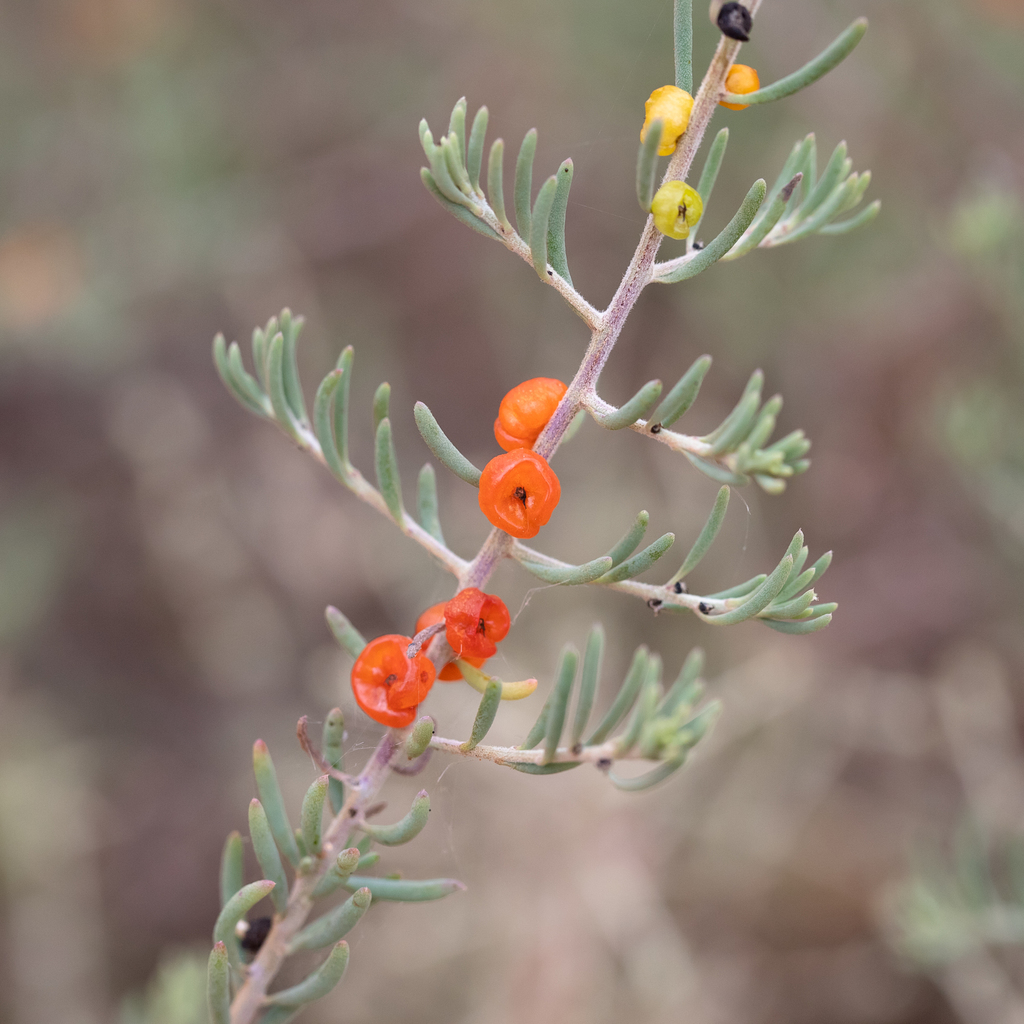
Enchylaena tomentosa
Enchylaena tomentosa commonly known as barrier saltbush or ruby saltbush,is a flowering plant in the family Amaranthaceae. It is a small shrub with greyish soft leaves, small flowers and fleshy berries.
Del artículo Enchylaena tomentosa de Wikipedia (CC BY-SA), citado sección por sección
Descripción
Enchylaena tomentosa grows as a small perennial shrub, up to a meter in diameter. Leaves are slender and cylindrical growing to 6-15mm long, both leaves and stems are densely covered in woolly hairs. Fruits form as fleshy berries changing from bright green/yellow to bright red/orange.
The derivation of the name helps describe and classify its features with Enchylaena coming from the Greek egchlos meaning fleshy or succulent and chlaen a cloak referring to the ripe fruiting perianth, tomentosa botanical Latin outlining that the plant is covered with dense short or curled hairs soft hair. Highly drought tolerant E. tomentosa has historically been sought after by Indigenous Australians, early settlers and livestock. Nutritional analyze gives the plant a 65% digestibility rating providing grazing species with 14% digestible protein and 6% digestible salt.
Wikipedia: «Description»
Distribución y hábitat
It occurs throughout Australia, and has also naturalised in New Caledonia. It tolerates a range of soils, but prefers soils that are slightly saline. Occurring through most of semi-arid Australia, on a variety of land and soil types such as sand plains, hill slopes, creek lines, sand dunes and salt lake shores. Preferring slightly shaded soil areas under trees such as Alectryon oleifolius and Acacia papyrocarpa. As the distribution map shows E. tomentosa is highly widespread throughout the continent, this is potentially due to a range of factors such as the plants drought resilience, ability to live in a wide range of soil/climate zones and also its seed dispersal method E. tomentosa seed is dispersed through endozoochory (seed that is dispersed through ingestion via another animal). This may potentially aid in germination of seeds, as digestion can result in the removal of fleshy pulp and the woody endocarp (scarification), these parts of the plants may act as inhibitors to germination as they can prevent germination occurring in unsuitable seasons and conditions. A study of emu scat and its seed composition found that E. tomentosa made up 8.5% of the near 20,000 seeds identified, second highest only to nitre bush (Nitraria billardierei) which made up 80% of identified seed. …
Wikipedia: «Distribution and habitat»
En la mesa
The ripened fruit of E. tomentosa can be picked and eaten raw and is described as being salty-sweet in flavor, being picked by desert Indigenous Australians as a snack food and is still frequently collected today. Indigenous groups of the Macdonell Ranges (central Australia) have been recorded to soak the fruits in water to make a sweetened tea. Charles Sturt on his explorations into the semi-arid interior also recorded harvesting the leaves, which could be eaten as a vegetable after being boiled. Major Thomas Mitchell noted on his explorations through the lower Murray that children would also harvest the fruit to make pink facial decorations. In terms of grazing value "E. tomentosa" is listed as a maintenance feed; as the plant does not provide enough grazing volume to act as a sole foraging source, its drought hardiness allows it to be available in dryer times of the year such as late summer when other palatable and nutritious forage sources are absent.
Wikipedia: «Human uses»
Dónde vive
Avistamientos registrados
—
registros georreferenciados en GBIF, de museos, herbarios y observadores de campo.
Arrastra el globo para girarlo. Los puntos marcan dónde hay registros, no un mapa de distribución; más oscuro significa más registros.
En los depósitos
Buscando en los depósitos…
Todas las páginas que nombran Enchylaena tomentosa en la Biodiversity Heritage Library →
Esta página se compone en directo a partir de iNaturalist, GBIF, Wikipedia, la Source Library y el Internet Archive. Aún no forma parte del códice editado a mano. Taxón 369256 de iNaturalist.