- Animales
- ›Cordados
- ›Vertebrados
- ›Reptiles
- ›Lagartijas y Serpientes
- ›Lagartijas, camaleones, iguanas y parientes
- ›Gecos y parientes
- ›Gecos, cuijas y parientes
- ›Gekko
- ›Japonigekko
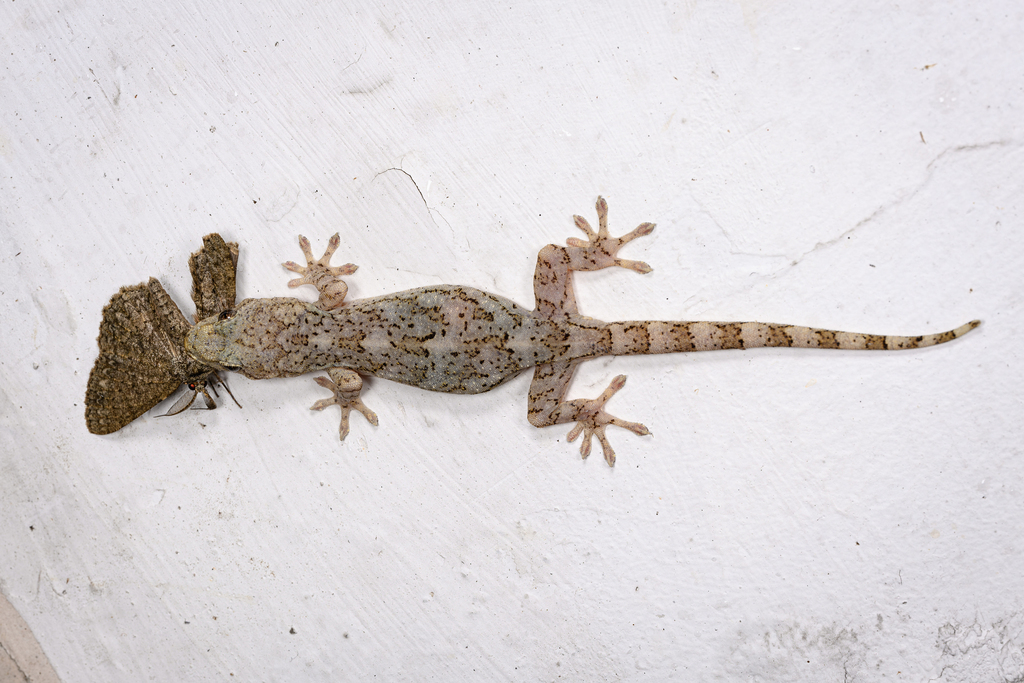
Gekko hokouensis
Gekko hokouensis, also known as the Hokou gecko or Kwangsi gecko, is a species of gecko. G. hokouensis is a small, nocturnal, arboreal, insectivorous gecko with reproduction occurring largely in the summertime. This species can be distinguished by subtle differences in body color and pattern as well as by the numbers and shape of some scales. Generally, G. hokouensis is colored with shades of brown, grey, or tan and has distinct, darker cross-bands on its back and tail. Its back and limbs are covered with small, granular scales intermixed with small, subconical tubercles that are larger and more numerous along the upper sides of the back. A key diagnostic feature is the presence of a large, undivided tubercular scale located on each side of the base of the tail. Additionally, as an adult, this species has a snout-vent length of roughly 60 mm.
Del artículo Gekko hokouensis de Wikipedia (CC BY-SA), citado sección por sección
Distribución y hábitat
G. hokouensis natural range includes southern Kyushu, Ryukyu Archipelago (except several islands), Taiwan (including Lanyus and Guishan islets), and southern and central eastern continental China. The species has also been found in the Nakadorijima and Hirashima islands near northwestern Kyushu, Yabitsu of Wakayama Prefecture, western Honshu, and Hachijojima Islands of the Izu Group. After G. japonicus, G. hokouensis has the second widest distribution area in the Japanese archipelago, occupying the forests and their edges, shrubs, and urban areas. Having significantly contracted during the last ice age, the suitable habitats for G. hokouensis and Gekko sp. are now expanding as the climate warms. They are found near human and urban habitations but also tend toward montane settings like secondary forests, rocky cliffs, and rock crevices at altitudes below 1,000 meters.
Wikipedia: «Distribution»
Lo que hace
In both its native and nonnative ranges, the gecko preys predominantly on insects and follows a nocturnal behavior pattern. Beyond insects, G. hokouensis diet consists of other arthropods and possibly fruits from inside human houses, possibly risking mortality during predation on some spiders. Excluding a predation case of a juvenile Okinawa Tree Lizard (Diploderma polygonatum), G. hokouensis has been considered a strict insectivore. Yet, in one study, the species was observed to feed on plant materials, possibly derived from feeding on tree sap or nectar. In several Gekko species, including G. hokouensis, males produce low amplitude calls and exhibit a tail-waiving display when courting females. The courtship call is composed of repetitive elements of multiple frequencies across a broadband spectrum with a very regular pattern. The temporal pattern in this call may convey some information about the male signaler, such as species identity, as in many frogs and insects. Female geckos have been shown to discriminate between the conspecific calls from white noise and tended to approach conspecific calls.
Wikipedia: «Behavior»
Dónde vive
Avistamientos registrados
—
registros georreferenciados en GBIF, de museos, herbarios y observadores de campo.
Arrastra el globo para girarlo. Los puntos marcan dónde hay registros, no un mapa de distribución; más oscuro significa más registros.
En los depósitos
Buscando en los depósitos…
Todas las páginas que nombran Gekko hokouensis en la Biodiversity Heritage Library →
Esta página se compone en directo a partir de iNaturalist, GBIF, Wikipedia, la Source Library y el Internet Archive. Aún no forma parte del códice editado a mano. Taxón 34612 de iNaturalist.