- Plantas
- ›Plantas vasculares
- ›Plantas con flores
- ›Magnolias, margaritas y parientes (dicotiledóneas)
- ›Menta, acantos, verbenas y afines
- ›Llantenes, campanitas, dedaleras y parientes
- ›Cheloneae
- ›Penstemon
- ›Penstemon
- ›Penstemon
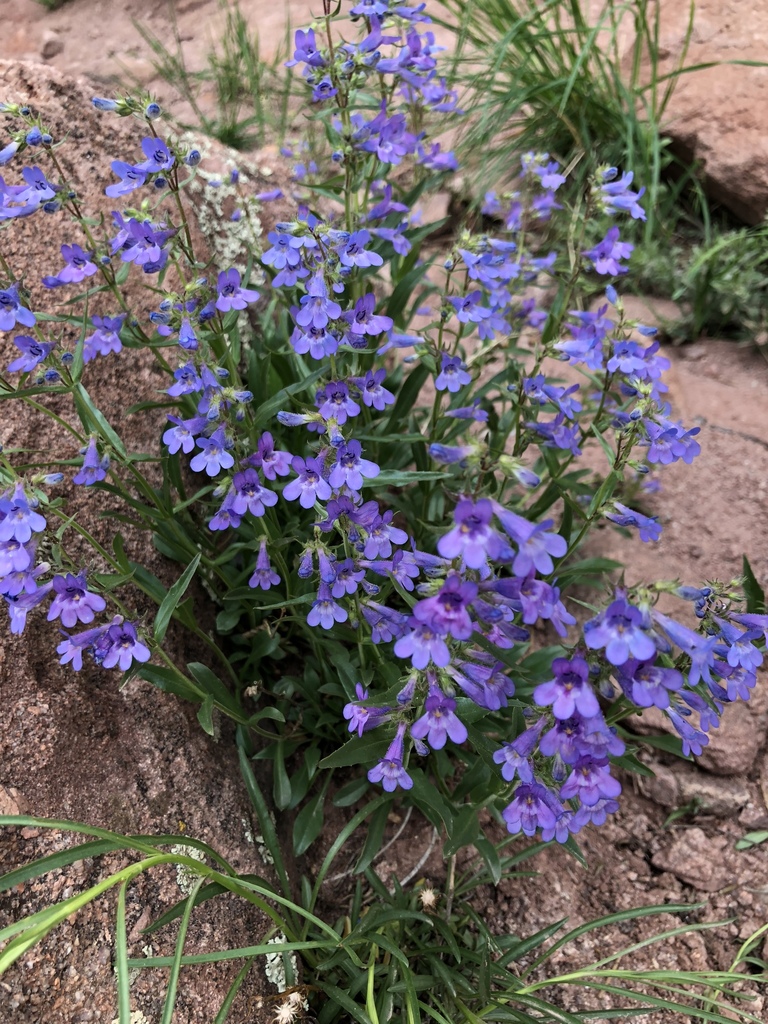
Penstemon virens
Penstemon virens, commonly known as blue mist penstemon, Front Range penstemon, or Green beardtongue, is a common Penstemon in the Front Range foothills in Colorado and Wyoming. The dainty flowers are an ornament to many rocky or sandy area within its range. It is confusingly similar to Penstemon humilis and Penstemon albertinus though the ranges of these plants do not overlap in the wild. The origin of calling it the "blue mist penstemon" is not precisely known, but is thought to relate to the large number of blue flowers the plant can produce reminding observers of a blue mist.
Del artículo Penstemon virens de Wikipedia (CC BY-SA), citado sección por sección
Descripción
Penstemon virens has flowering stems are typically 10–40 cm in height and stand upright with very little curve. The stems are covered in extremely fine and short hairs that increase to being glandular and hairy closer to the buds and flowers, but are rarely almost or completely hairless. Most of the leaves are at the base of the plant and relatively short, 2–10.2 cm long. These basal leaves are bright green, smooth, shiny, and have smooth or very finely toothed edges (denticulate margins). Though smooth, the leaves are not leathery or thick, and are oblanceolate to spatulate with a tapered base and 4–15 mm in width. The end of the leaves are mildly pointed, ranging from obtuse to acute. The leaves attached to the flowering stems are also hairless, have smooth leaf edges, lancelolate to slightly ovate in shape, and shorter than the basal leaves, 1.8–5 cm in length and 3–14 mm wide. The form of the plant is a low, spreading mat that enlarges each year, with leaves that persist over the winter in most locations. The flowering stem is a thyrse, it grows without a genetically determined limit, but instead stops due to environmental conditions. It will typically have 3-6 clusters of flowers on the stem just above each leaf pair. …
Wikipedia: «Description»
Distribución y hábitat
Penstemon virens is commonly found growing on rocky slopes, on rock outcrops, in forest openings, along road cuts, and other disturbed areas. They grow from 1600 to 3000 m in elevation. Penstemon virens is common in its habitat, but not widely distributed. Plants are found on the Medicine Bow Range in southeastern Wyoming south to Culebra Range in southeastern Colorado. It is common in the mountains and foothills of the Front Range in between and also on the Palmer Divide in Colorado. It is recorded by the USDA Natural Resources Conservation Service PLANTS database (PLANTS) with county level records in Colorado and Wyoming. NatureServe assessed P. virens as globally vulnerable (G3) in 1993. At the state level they did not assess populations in Colorado and evaluated Wyoming populations as "imperiled" (S2).
Wikipedia: «Habitat and distribution»
Lo que hace
Penstemon virens tend to grow together in large numbers rather than singly or scattered throughout the landscape, rarely fewer than 10 plants in a population. Most species observed visiting and entering the flowers of P. virens are bees. The most frequent visitors are members of genus Lasioglossum, but genus Osmia, genus Bombus, and honeybees also frequently visit them. Specific species observed include Apis mellifera, Augochlorella aurata, Bombus huntii, Bombus rufocinctus, Bombus centralis, Halictus tripartitus, Hoplitis truncata, Lasioglossum sisymbrii, and Lasioglossum trizonatum. They are also sometimes visited by beeflies (Bombyliidae) and butterflies, but they have not been observed contacting reproductive parts and are thought to be necatar robbers. Hummingbirds, though present in the range, have not yet been scientifically observed visiting P. virens. A study of plant responses to wildfire found that Penstemon virens was found in similar number of areas before and after five years of recovery from fires. Though it does recover from fires an earlier study found that P. virens is significantly associated with areas of historic low-intensity fires in ponderosa pine forests. Penstemon virens was evaluated as a potential host for Castilleja integra and was found by the researchers to not support this partially parasitic plant for more than a few weeks.
Wikipedia: «Ecology»
Cómo se cultiva
Blue mist penstemons are recommended as garden plants by local governments, water providers, and extension services for areas in or near the Front Range. They are prized for their low water usage, adaptation to local climate, handsome blooms, long lifespan, and ease of cultivation. They are drought tolerant once established, but not adapted to constantly dry conditions. In garden settings they are adapted to full sun to partial shade conditions in the west and full sun in the east of the United States. They are quite adaptable to different garden soil conditions, but like all penstemons are healthier with good drainage. Dr. Dale Lindgren of the University of Nebraska writes that their seeds require cold and moist stratification of six weeks at 4.5 °C for good germination rates or to be planted outside over the winter. However, experiments by Dr. Norman C. Deno indicate that period of dry warm storage of around 21 °C (70 °F) for six months before cool moist stratification is critical. His research also showed that seeds left in the dry stems after ripening accomplish the same effect in natural settings. The coldest USDA hardiness zones where this plant is known to survive is zone 4.
Wikipedia: «Cultivation»
Dónde vive
Avistamientos registrados
—
registros georreferenciados en GBIF, de museos, herbarios y observadores de campo.
Arrastra el globo para girarlo. Los puntos marcan dónde hay registros, no un mapa de distribución; más oscuro significa más registros.
En los depósitos
Buscando en los depósitos…
Todas las páginas que nombran Penstemon virens en la Biodiversity Heritage Library →
Esta página se compone en directo a partir de iNaturalist, GBIF, Wikipedia, la Source Library y el Internet Archive. Aún no forma parte del códice editado a mano. Taxón 166459 de iNaturalist.