- Plantas
- ›Plantas vasculares
- ›Plantas con flores
- ›Magnolias, margaritas y parientes (dicotiledóneas)
- ›Menta, acantos, verbenas y afines
- ›Llantenes, campanitas, dedaleras y parientes
- ›Cheloneae
- ›Penstemon
- ›Penstemon
- ›Gentianoides
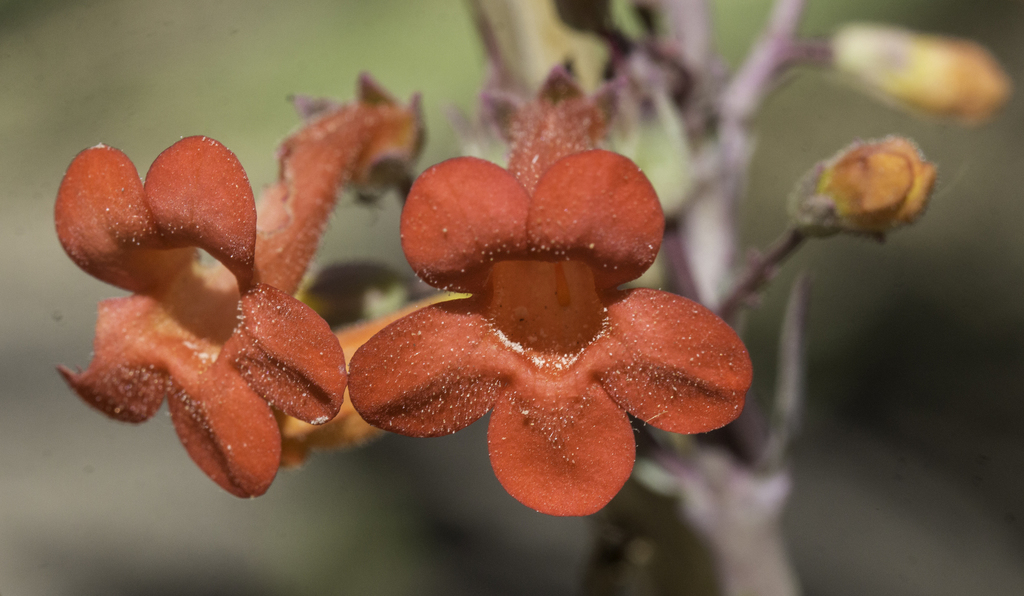
Penstemon alamosensis
Penstemon alamosensis, commonly known as Alamo penstemon, is a rare species of penstemon from New Mexico and Texas. It is known for its tall flowering stems with coral-red flowers.
Del artículo Penstemon alamosensis de Wikipedia (CC BY-SA), citado sección por sección
Descripción
Alamo penstemon is a variable species which can have flowering stems as short as 14 centimeters (5.5 in) or as tall as 1.2 meters (3.9 ft). Plants can have one or a few stems; the stems are slender, green or slightly gray-green, and hairless. Like the stems, the leaves are sometimes glaucous, always hairless, and are also not leathery. Plants have both basal leaves and two to six pairs of leaves attached to the flowering stems. The basal leaves have a petiole, a leaf stem, that is about as long as the leaf blade. The basal leaves and the lowest ones on the stems are elliptic to obovate or lanceolate and measure 2.5–14 cm long while 0.9–4.5 cm wide. Leaves on the flowering stems lack leaf stems, instead the base of the leaf attaches directly to the main stem. The upper leaves are reduced in size measuring 1–13.5 cm long and 0.3–3 cm wide, with a usual proportion being about four times long as they are wide. Flowering occurs in its native habitat in April, May, or June. The flowers are a bright coral-red trumpet opening to a nearly symmetrical face. The mouth of the flower has five lobes, three downwards and two towards the top with rounded ends. The flower measures 1.9–2.5 cm long and is covered with glandular hairs on the outside. …
Wikipedia: «Description»
Distribución y hábitat
The species is native to just two US states, New Mexico and Texas. The majority of its range is in New Mexico where it grows in the Sacramento Mountains in Otero and Lincoln counties and in the San Andres Mountains in Doña Ana County. In Texas it is found in the Hueco Mountains in El Paso County, the state's westernmost county. The elevation range for Alamo penstemon is 1,300–1,600 meters (4,300–5,200 ft). In Texas plants are often found in north facing locations and somewhat moist canyon bottoms. Less often they grow from rock crevices or amid bushes that shelter them from grazing.
Conservation. When it was evaluated in 1997 NatureServe evaluated Alamo penstemon as vulnerable at the global level (G3) and at the state level in New Mexico (S3). In Texas they rated it critically imperiled (S1). Most of the locations where it grows are inaccessible and safe from current land uses, but due to the attractiveness of its flowers, plants in frequently visited places are vulnerable to collecting. A 1995 inventory of the species estimated there to be 5000 mature plants spread across 25 locations in New Mexico.
Wikipedia: «Range and habitat»
Cómo se cultiva
Alamo penstemons are somewhat rare in cultivation, but the seeds are occasionally available, especially from dealers in the southwestern United States. Its seeds require one to three months of cold-moist stratification to stimulate large percentages to sprout. Gardeners plant it in low-water or rock gardens as a plant to attract hummingbirds and for the beauty of its coral-red blooms.
Wikipedia: «Cultivation»
Dónde vive
Avistamientos registrados
—
registros georreferenciados en GBIF, de museos, herbarios y observadores de campo.
Arrastra el globo para girarlo. Los puntos marcan dónde hay registros, no un mapa de distribución; más oscuro significa más registros.
En los depósitos
Buscando en los depósitos…
Todas las páginas que nombran Penstemon alamosensis en la Biodiversity Heritage Library →
Esta página se compone en directo a partir de iNaturalist, GBIF, Wikipedia, la Source Library y el Internet Archive. Aún no forma parte del códice editado a mano. Taxón 166317 de iNaturalist.