- Hongos
- ›Setas, royas y tizones
- ›Agaricomycotina
- ›Setas, bejines y parientes
- ›Agaricomycetidae
- ›Hongos con láminas
- ›Hygrophorineae
- ›Hygrophoraceae
- ›Hygrocyboideae
- ›Hygrocybeae
- ›Hygrocybe
- ›Pseudohygrocybe
- ›Coccineae
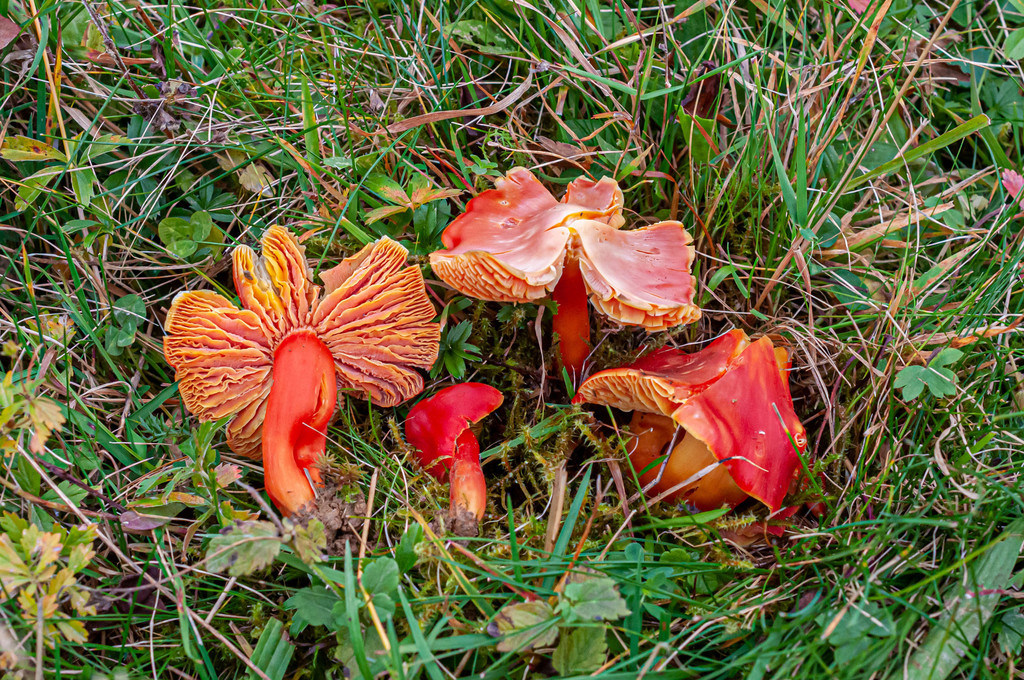
Hygrocybe splendidissima
Hygrocybe splendidissima, is a species of agaric (gilled mushroom) in the family Hygrophoraceae. It has been given the recommended English name of splendid waxcap. The species has a European distribution, occurring mainly in agriculturally unimproved grassland. Threats to its habitat have resulted in the species being assessed as globally "vulnerable" on the IUCN Red List of Threatened Species.
Del artículo Hygrocybe splendidissima de Wikipedia (CC BY-SA), citado sección por sección
Descripción
The basidiocarps are agaricoid, up to 10 cm (4 in) tall, the cap conical to convex at first, retaining a broad umbo or becoming flat when expanded, up to 7 cm (2+3⁄4 in) across. The cap surface is smooth and dry, deep scarlet, paler when dry. The lamellae (gills) are waxy, cap-coloured or orange. The stipe (stem) is smooth, cap-coloured to orange, lacking a ring. The spore print is white, the spores (under a microscope) smooth, inamyloid, ellipsoid, c. 7.5 to 9.0 by 4.5 to 5.5 μm. Fruit bodies have a distinct honey smell when rubbed or when drying.
Similar species. The species can normally be distinguished in the field, thanks to its size and colour. It was formerly confused with Hygrocybe punicea (the crimson waxcap), but fruitbodies of the latter species are a darker, duller red, have slightly viscid caps, and fibrillose stems. Fruit bodies of H. coccinea (scarlet waxcap) are typically much smaller and have slightly viscid caps that are nodulose under a lens. Both these species lack the distinctive smell of H. splendidissima, though the much smaller, orange-red H. reidii also has a honey smell.
Wikipedia: «Description»
Distribución y hábitat
The splendid waxcap is widespread but generally rare throughout Europe, with the largest populations in the United Kingdom, Germany, Sweden, Denmark, and Norway. Like other waxcaps, it occurs in old, agriculturally unimproved, short-sward grassland (pastures and lawns). Recent research suggests waxcaps are neither mycorrhizal nor saprotrophic but may be associated with mosses.
Wikipedia: «Distribution and habitat»
Dónde vive
Avistamientos registrados
—
registros georreferenciados en GBIF, de museos, herbarios y observadores de campo.
Arrastra el globo para girarlo. Los puntos marcan dónde hay registros, no un mapa de distribución; más oscuro significa más registros.
En los depósitos
Buscando en los depósitos…
Todas las páginas que nombran Hygrocybe splendidissima en la Biodiversity Heritage Library →
Esta página se compone en directo a partir de iNaturalist, GBIF, Wikipedia, la Source Library y el Internet Archive. Aún no forma parte del códice editado a mano. Taxón 118317 de iNaturalist.