- Animales
- ›Cordados
- ›Vertebrados
- ›Reptiles
- ›Lagartijas y Serpientes
- ›Serpientes y culebras
- ›Víboras y parientes
- ›Víboras del Viejo Mundo
- ›Macrovipera
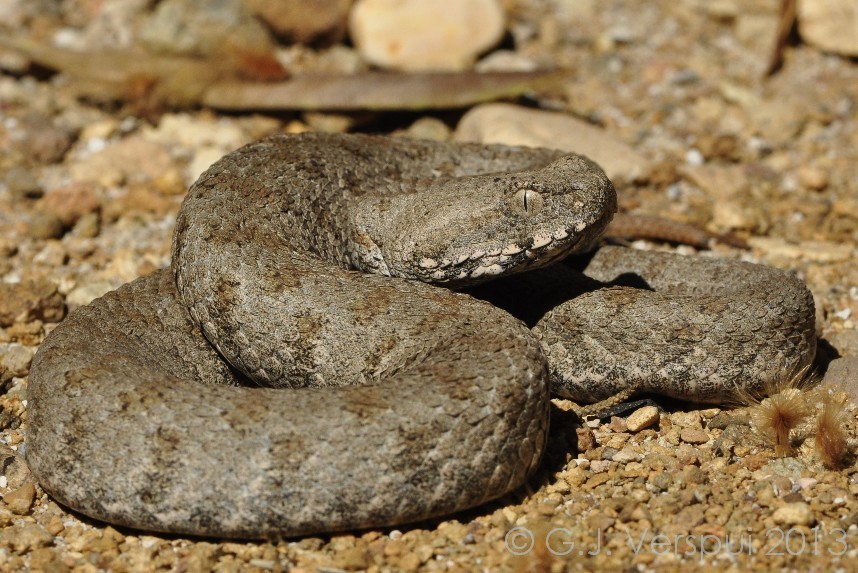
Macrovipera lebetinus
Macrovipera lebetinus, known as the blunt-nosed viper, Lebetine viper, Levant viper, and by other common names, is a viper species found on islands in the Aegean Sea, in Algeria, and in much of the Middle East, and as far east as India. Like all other vipers, it is venomous. Six subspecies are currently recognized, including the nominate race described here.
Del artículo Macrovipera lebetinus de Wikipedia (CC BY-SA), citado sección por sección
Descripción
This is a large snake, with females reaching 150 cm (59.1 in) in total length (body + tail) and males a little less. Sizes vary among different populations, with M. l. lebetina being somewhat smaller. The head is broad, triangular, and distinct from the neck. The snout is rounded and blunt when viewed from above, which is why it is also called the blunt-nosed viper. The nasal and nasorostral scales are almost completely fused into a single plate, although some variation occurs. The dorsal scales are strongly keeled, except for those bordering the ventrals. M. l. lebetina usually has 146-163 ventral scales. The anal scale is single. The color pattern is less varied than one might expect from a species that is so widely distributed. The head is normally uniformly colored, although it can occasionally be marked with a dark V-shape. Dorsally, the ground color of the body can be gray, brown, beige, pinkish, olive, or khaki. The pattern, if present, is darker. It can be gray, bluish, rust, or brown in color, and may consist of a middorsal row or double row of large spots. When two rows are present, the spots may alternate or oppose, which can produce anything from a saddled to a continuous zigzag pattern. The spots are usually brown, dark gray, or black, but are sometimes red, brick, yellow, or olive in color. …
Wikipedia: «Description»
Distribución y hábitat
It may be found under short trees with thick shade if the outside temperature is greater than 45 °C.
Wikipedia: «Habitat»
Dónde vive
Avistamientos registrados
—
registros georreferenciados en GBIF, de museos, herbarios y observadores de campo.
Arrastra el globo para girarlo. Los puntos marcan dónde hay registros, no un mapa de distribución; más oscuro significa más registros.
En los depósitos
Buscando en los depósitos…
Todas las páginas que nombran Macrovipera lebetinus en la Biodiversity Heritage Library →
Esta página se compone en directo a partir de iNaturalist, GBIF, Wikipedia, la Source Library y el Internet Archive. Aún no forma parte del códice editado a mano. Taxón 105083 de iNaturalist.