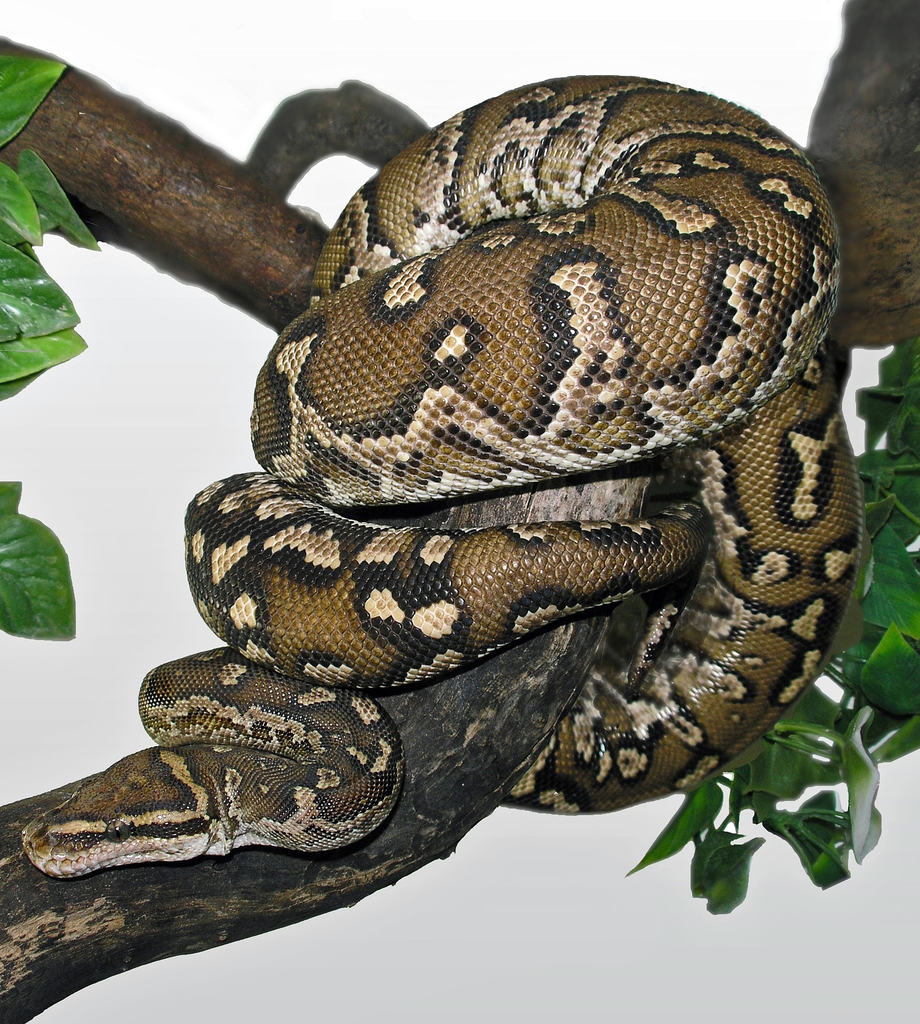
Pitón de Angola
Python anchietae
Python anchietae (with common names Angolan python and Anchieta's dwarf python) is a python species endemic to southern Africa. According to Donald George Broadley (1990), this species is most closely related to the ball python (P. regius) of western Africa, and no subspecies are currently recognized. It is named after the Portuguese naturalist and explorer José Alberto de Oliveira Anchieta. Like all other pythons, it is not venomous.
Del artículo Python anchietae de Wikipedia (CC BY-SA), citado sección por sección
Descripción
Python anchietae may grow up to 183 cm (6 ft) in total length (including tail). The color pattern is a reddish-brown to brown to almost black ground, overlaid with irregular white or cream-colored bands and spots. The belly is yellowish. A rare species seldom seen in the wild or in captivity, it is the only python to have "bead-like" head scales. It has heat sensitive pits, five on each side of the head, on the upper lip. The smooth dorsal scales are arranged in 57-61 rows.
Wikipedia: «Description»
Distribución y hábitat
Python anchietae is found in Africa in southern Angola and northern Namibia. The type locality given is "Catumbella [Catumbela]" near Lobito, Angola. Habitats are rocky outcrops or areas strewn with rocks in open brush or grassland. Diurnal, they shelter in small caves, overhangs and crevices.
Wikipedia: «Distribution and habitat»
Lo que hace
Python anchietae exhibits hisses, which are mostly bluff. Its diet consists of small mammals and birds. It is oviparous, with small clutches of four to five eggs being produced at a time. Hatchlings are 43–46 cm (17–18 in)long.
Wikipedia: «Behaviour and biology»
Dónde vive
Avistamientos registrados
—
registros georreferenciados en GBIF, de museos, herbarios y observadores de campo.
Arrastra el globo para girarlo. Los puntos marcan dónde hay registros, no un mapa de distribución; más oscuro significa más registros.
En los depósitos
Buscando en los depósitos…
Todas las páginas que nombran Python anchietae en la Biodiversity Heritage Library →
Esta página se compone en directo a partir de iNaturalist, GBIF, Wikipedia, la Source Library y el Internet Archive. Aún no forma parte del códice editado a mano. Taxón 32160 de iNaturalist.