- Animales
- ›Cordados
- ›Vertebrados
- ›Reptiles
- ›Lagartos y serpientes
- ›Serpientes y culebras
- ›Culebras y parientes
- ›Culebras típicas
- ›Tantilla
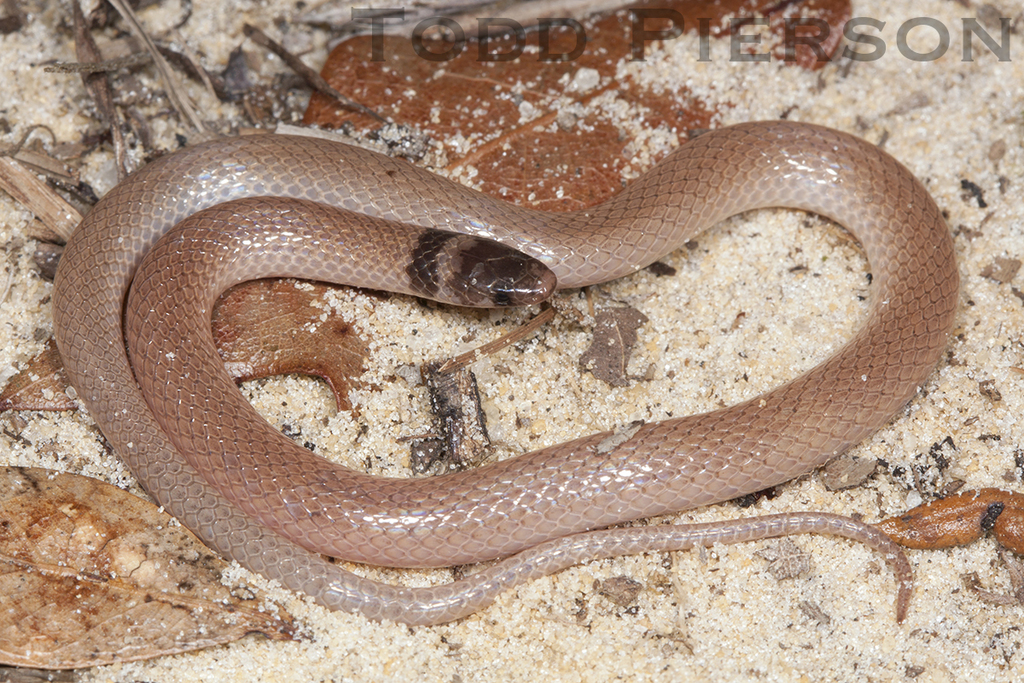
Tantilla relicta
The Florida crowned snake (Tantilla relicta) is a species of snake in the subfamily Colubrinae of the family Colubridae. The species is native to peninsular Florida and extreme southern Georgia. It is a small, slender, snake that is rarely seen, and is most often associated with sandy habitats. There are three recognized subspecies.
Del artículo Florida crowned snake de Wikipedia (CC BY-SA), citado sección por sección
Descripción
The Florida crowned snake is a small, slender snake. Adults are usually 7–9 inches (17–22 cm) in total length (tail included). Dorsally, the snake is tan, light brown or reddish brown in color. It has a brown-black head, chin, and parts of the neck. Some individuals have a pattern on the head of a pale band. The band marking may be absent in individuals from north-central Florida. It can also have a dark neck band. The underside can be white, pink or whitish-yellow. The maximum recorded total length (tail included) of the species is 24 cm (9.5 in). The nose may be cream-tan in color in populations found along the Atlantic Coast.
Wikipedia: «Description»
Distribución y hábitat
The Florida crowned snake is commonly found in north and central Florida, and in sandy habitat areas of the Gulf coast. The species is seen rarely in the southernmost border area of Georgia. It is most often associated with sandy habitats, including Florida sand pine scrub, pine flatwoods and pine hammocks.
Wikipedia: «Natural habitat»
Lo que hace
The Florida crowned snake is most active in the warmest months of the year. During the winter, it spends the majority of its time burrowed in loose, sandy soils, including mounds created by burrowing animals. It also will hide under rocks or organic litter. It is rarely seen out in the open. It has been observed occupying pocket gopher and gopher tortoise burrows. Diet includes worms, snails, spiders, centipedes, and insects and their larvae. The snake has been observed eating beetle larvae. The populations found primarily in Florida have very large rear teeth that possibly direct venom into their prey. The species is harmless to humans.
Wikipedia: «Behavior and diet»
En la cultura humana
Three subspecies of Tantilla relicta are recognized as being valid, including the nominotypical subspecies. The subspecific name, neilli, is in honor of American herpetologist Wilfred T. Neill.
Tantilla relicta neilli Telford, 1966 Tantilla relicta pamlica Telford, 1966 Tantilla relicta relicta Telford, 1966
Wikipedia: «Taxonomy and etymology»
Dónde vive
Avistamientos registrados
—
registros georreferenciados en GBIF, de museos, herbarios y observadores de campo.
Arrastra el globo para girarlo. Los puntos marcan dónde hay registros, no un mapa de distribución; más oscuro significa más registros.
En los depósitos
Buscando en los depósitos…
Todas las páginas que nombran Tantilla relicta en la Biodiversity Heritage Library →
Esta página se compone en directo a partir de iNaturalist, GBIF, Wikipedia, la Source Library y el Internet Archive. Aún no forma parte del códice editado a mano. Taxón 28484 de iNaturalist.