- Animales
- ›Cordados
- ›Vertebrados
- ›Anfibios
- ›Salamandras, ajolotes y parientes
- ›Salamandras acuáticas
- ›Necturus
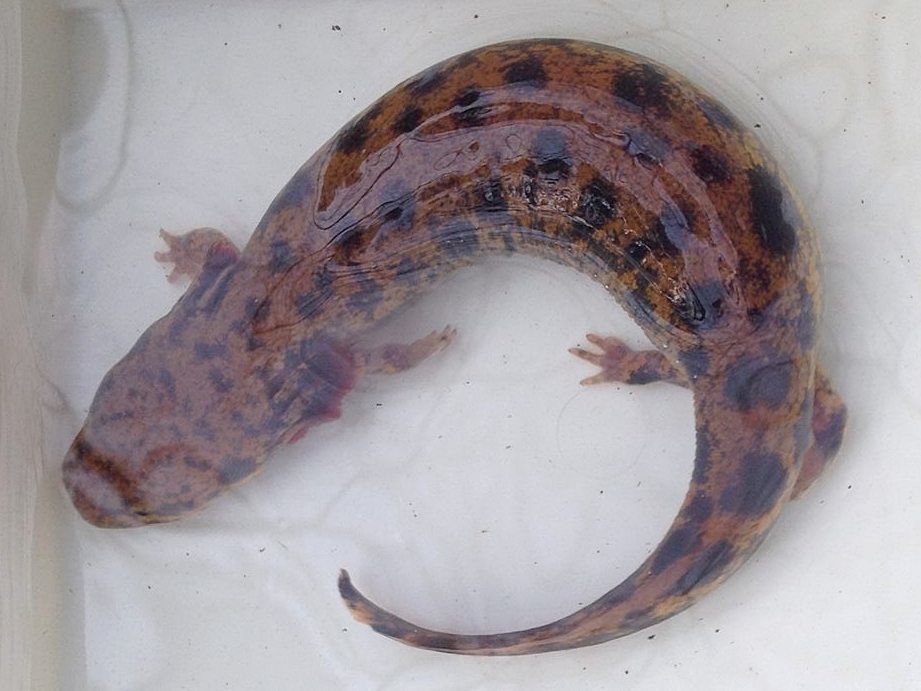
Necturo de Neuse River
Necturus lewisi
The Neuse River waterdog (Necturus lewisi) is a medium-sized waterdog of the family Proteidae found in streams and rivers in two watersheds of North Carolina.
Del artículo Neuse River waterdog de Wikipedia (CC BY-SA), citado sección por sección
Descripción
N. lewisi has a rusty-brown dorsal side with many large, bluish-black spots. The ventral side is dark brown to grey and also spotted. The snout is compressed dorsally and truncated. The tail is compressed laterally and ridged. Each hind limb has four toes, and the gills are dull red and bushy. Sexually active males have sowled cloacae and two enlarged cloacal papillae that point to the rear. Males and females are of a similar size. Adults measure 16.5–28.0 cm from the tip of snout to tip of tail. The young possess a dorsal stripe along their length along with a dark lateral stripe. Males and females become sexually mature after reaching 102 mm and 100 mm, respectively, measured from tip of the snout to the posterior end of the cloaca. This size is reached at 5.5 years in males and 6.5 years in females.
Wikipedia: «Appearance and physiology»
Distribución y hábitat
The range of the Neuse River waterdog is limited to the Neuse and Tar-Pamlico River basins in the eastern Piedmont and Coastal Plain of North Carolina.
Wikipedia: «Range»
Lo que hace
Males have sperm in the vasa deferentia from November through May, and females have been found with this sperm from December through May. Females move to nesting sites beneath fast-moving current during the spring. They lay eggs under rocks or woody debris. Oviposition occurs in April and May, corresponding to the time when ovarian eggs reach their maximum size. Eggs are 8–9 mm in diameter and attach to the substrate by a blunt stalk. Larvae hatch around June and reach sexual maturity at 5.5 to 6.5 years old.[1]
Courtship. A pair of Neuse River waterdogs crawl slowly, with the male trailing the female by 2–4 cm. The male positions his snout behind the rear legs of the female when she stops. The female has her gills flared, while the male has his close to the neck. The male then moves across her body at the base of her tail. Once parallel, the male begins to stroke the female with his chin. This stroking begins at the top of the head, moves roughly halfway down the female and back to the head. The female then raises her head each time the male's chin contacts her neck or head. This sequence repeats many times over a period of roughly 18 minutes. The male then circles the female in a clockwise direction while maintaining contact with her. After several slow circles are made, the males moves parallel to the female and places his limbs over her back. …
Wikipedia: «Reproduction»
Escuchar
Buscando grabaciones de campo…
Dónde vive
Avistamientos registrados
—
registros georreferenciados en GBIF, de museos, herbarios y observadores de campo.
Arrastra el globo para girarlo. Los puntos marcan dónde hay registros, no un mapa de distribución; más oscuro significa más registros.
En los depósitos
Buscando en los depósitos…
Todas las páginas que nombran Necturus lewisi en la Biodiversity Heritage Library →
Esta página se compone en directo a partir de iNaturalist, GBIF, Wikipedia, la Source Library y el Internet Archive. Aún no forma parte del códice editado a mano. Taxón 27688 de iNaturalist.