- Animales
- ›Cordados
- ›Vertebrados
- ›Peces con aletas radiadas
- ›Acanthomorpha
- ›Anabantiformes
- ›Channoidei
- ›Channidae
- ›Parachanna
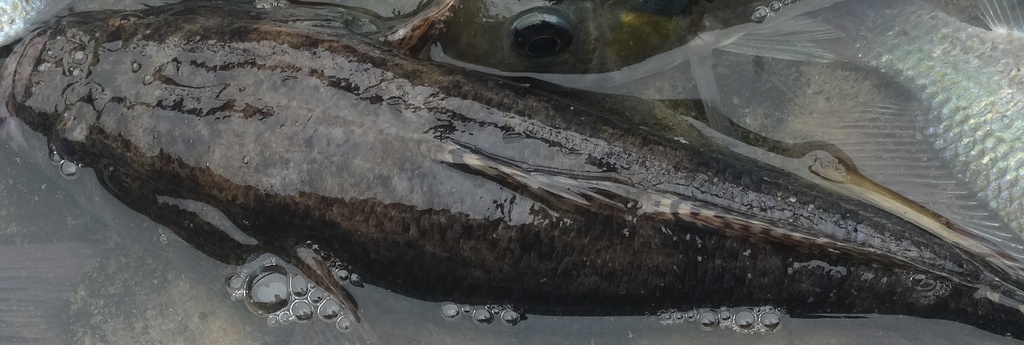
Parachanna africana
Parachanna africana, the African snakehead or Niger snakehead, is a species of fish from west-central Africa. Little is published on its biology. Limited primarily to coastal sections of rivers, it is thought to be a nest-building, thrust predator like other Channidae.
Its native range is southern Benin to southern Nigeria, primarily the Oueme River and the basin of the Niger River. In Nigeria, it is used for human consumption and used in medicine.
Del artículo Parachanna africana de Wikipedia (CC BY-SA), citado sección por sección
Descripción
Diagnosis: The body of the species is elongated, tapering backwards; lateral line scale medium-sized, head depressed anteriorly and covered with larger scales. Lower jaw slightly longer than upper, with 3–4 well developed canines; dorsal fin with 45–48, 8–11 Chevron-shaped dark bars onside. Coloration: The body color is light to dark grey, back and top of the head darker, underside lighter, dark lateral band on head, broadening between hind margin of the eye and hind margin of Gill cover, followed by a large, rounded black spot; small rounded black spot at the caudal fin. This species is sometimes mistaken for its congener P. obscura, but following Bonou and Teugal (1985), P. Africana can be distinguished from P. obscura by the following combination of characteristics since sometimes they are misapplied:
Colour pattern is unique – Parachanna africana has a series of 8–11 dark chevron-shaped markings extending along the body posterior to the operculum 19–24 scales in the transverse series Lateral line complete with 73–83 pores scales 32–35 anal-fin rays. Most times, the chevron marking may not be visible in a live specimen; this depends on the mood of the fish.
Wikipedia: «Description»
Distribución y hábitat
P.africana are freshwater species; Benthopelagic species. They primarily inhabit lowlands, coastal river basins, swamps, lakes, and man-made reservoirs.
Wikipedia: «Habitat»
Lo que hace
P.africana is an ambush predator that feeds on smaller fishes and invertebrates in nature but in most cases adapts well to dead alternatives in Captivity. Some specimen accepts dried food though these should never form the stable diet. Young fish can be fed with chironomid larvae (blood worm), small earthworms, chopped prawns and suchlike while adults will accept strips of fish flesh, whole prawns, mussels, live river shrimps, larger earthworms etc. Older individuals do not require feeding on daily basis, with 2–3 times per week sufficient. Note that, this species should not be fed mammalian or avian mean for example beef heart or chicken since some of the lipids contained in these cannot be properly metabolised by the fish and may cause excess fat deposits and even organ degeneration.
Wikipedia: «Diet»
Dónde vive
Avistamientos registrados
—
registros georreferenciados en GBIF, de museos, herbarios y observadores de campo.
Arrastra el globo para girarlo. Los puntos marcan dónde hay registros, no un mapa de distribución; más oscuro significa más registros.
En los depósitos
Buscando en los depósitos…
Todas las páginas que nombran Parachanna africana en la Biodiversity Heritage Library →
Esta página se compone en directo a partir de iNaturalist, GBIF, Wikipedia, la Source Library y el Internet Archive. Aún no forma parte del códice editado a mano. Taxón 108424 de iNaturalist.