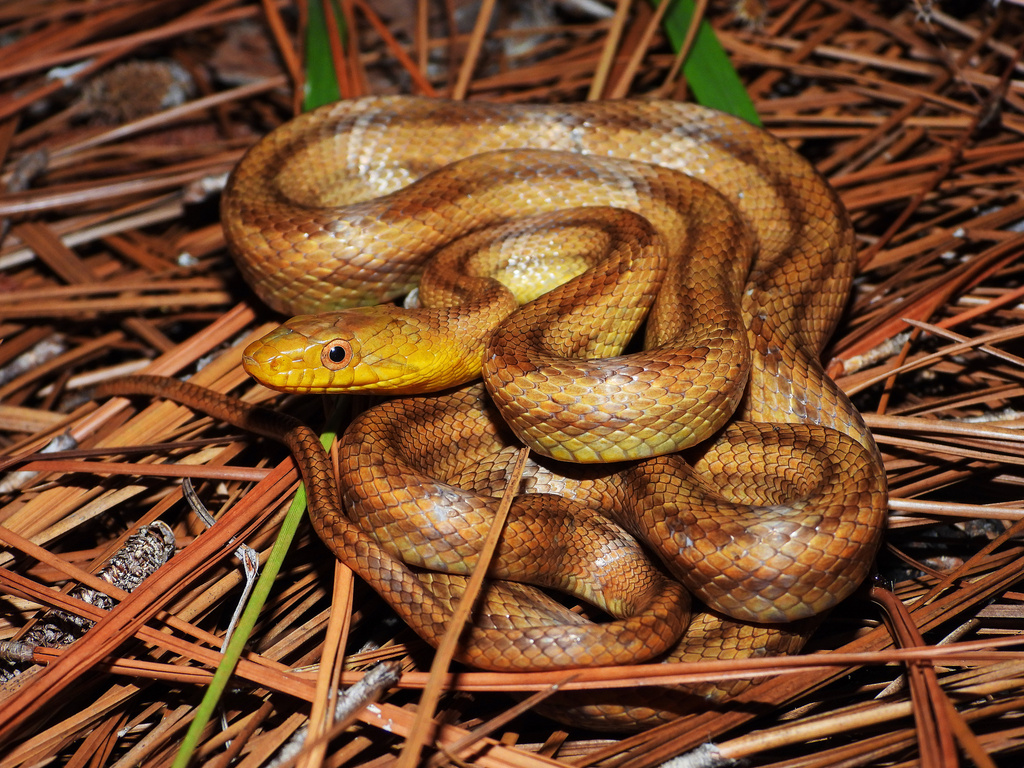


Yellow Rat Snake (quadrivittata)
Pantherophis quadrivittatus (Holbrook, 1836)
Pantherophis quadrivittatus, commonly called the yellow ratsnake or eastern ratsnake, is a species of nonvenomous snake in the family Colubridae. The species is endemic to North America.
- Registrada en
- USA (Virginia, South Carolina, North Carolina, Georgia [east of the Chattohoochee River], Florida [east of the Apalachicola River]).
- También publicada como
- Coluber quadri-vittatus Holbrook, 1842; Coluber quadrivittatus Holbrook, 1836; Coluber obsoletus lemniscatus Cope, 1888; Coluber reticularis Daudin, 1803; Elaphe obsoleta rossalleni Neill, 1949; Elaphe quadrivittata deckerti Brady, 1932; Elaphe quadrivittata parallela Barbour & Engels, 1942; Elaphe williamsi Barbour & Carr, 1940; Elaphis holbrookii Duméril & Bibron, 1854
De Wikipedia (CC BY-SA), citada sección por sección
Descripción
Adult eastern rat snakes commonly measure 90 to 183 cm (2 ft 11 in to 6 ft 0 in) in total length (including tail), with a few exceeding 200 cm (6 ft 7 in). The longest recorded total length to date for an eastern rat snake is 228 cm (7 ft 6 in). A sample of eastern rat snakes, including juvenile and adult snakes, weighed from 54 to 1,274 g (0.119 to 2.809 lb). A further adult weighed 833 g (1.836 lb). Adults in the north of its range are shiny black dorsally, with a cream or white chin and throat. White areas of skin can appear between scales. The belly has an irregular black-and-white checkerboard pattern, becoming uniformly slate gray towards the tail. Juveniles have 28 to 40 dark dorsal blotches on a grayish ground color. The ventral pattern in juveniles is the same as in adults. The eyes are round with a black pupil, with particularly in juveniles, but not always present in adults, a distinct white margin. In the Florida Peninsula, adult rat snakes can be yellow, orange, tan, or gray, with four dark, longitudinal stripes. In cross section, the bodies of rat snakes are not round, but instead resemble a loaf of bread. The dorsal scales are weakly keeled, and are arranged in 23 to 27 rows at midbody. Males and females have the same coloration. Males have proportionally longer tails (16–19% of total body length) compared to females (14–18% of total body length).
Distribución y hábitat
Pantherophis quadrivittatus is found in the United States east of the Apalachicola River in Florida, east of the Piedmont in Virginia, South Carolina, North Carolina, Georgia, and south to the Florida Keys. On the western and northern edges of its range, it readily hybridizes with the central ratsnake (Pantherophis alleghaniensis). The two species wide hybrid zone of up to 256 km (159 miles) in width and encompassing much of the northeastern United States and Piedmont, making species-level identification in these regions difficult.
Lo que hace
The eastern rat snake is primarily active at night during the summer, and diurnal in the spring and fall. It is a terrestrial burrower and an excellent climber, and it may enter water. It is found under rocks and boards, and in trees under bark and within knotholes and palm fronds. Eastern rat snakes have been found using water-filled cavities in trees, with many using the cavities at the same time. Gravid females were also four times more likely to use the water cavities than non-gravid females or male ratsnakes. Gravid females prefer edge habitat more extensively than males and non-gravid females, this is because of the need for gravid females to retain higher body temperature. The snake is a constrictor, and adults eat mainly endotherms, while young eat mainly ectotherms. The diet includes rodents, lizards, frogs, and birds and their eggs. The snakes can also eat young chickens and chicks, hence the common name chicken snake. Rat snakes are most vulnerable to predators as juveniles. Predators of P. quadrivittatus include hawks (Buteo spp.), great horned owls (Bubo virginianus), foxes, raccoons, and domestic cats. Adult eastern rat snakes have few known predators other than humans. When frightened, a rat snake will freeze. If harassed, it will produce a foul-smelling musk to deter predators. …
En la cultura humana
The generic name Pantherophis, meaning "panther-like snake", is from Ancient Greek: πάνθηρ: pánthēr, "panther" and Ancient Greek: ὄφις: óphis, "snake". The specific name quadrivittatus, meaning "four-striped," refers to the four stripes on the species in the southern part of its range.
Dónde se ha registrado
Avistamientos registrados
—
registros georreferenciados en GBIF, de museos, herbarios y observadores de campo.
Arrastra el globo para girarlo. Los puntos marcan dónde hay registros, no un mapa de distribución; más oscuro significa más registros.
En los depósitos
Buscando en los depósitos…
Todas las páginas que nombran Pantherophis quadrivittatus en la Biodiversity Heritage Library →
Referencias
- Camper, Jeffrey D. (2019). The Reptiles of South Carolina. University of South Carolina Press, 288 Pp. [Review in Copeia 107 (3): 590, 2019].
- Duméril, A.M.C., G. BIBRON & A.H.A. DUMÉRIL. (1854). Erpétologie générale ou Histoire Naturelle complète des Reptiles. Vol. 7 (partie 1). Paris, Xvi + 780 S.
- Schulz, & Klaus-Dieter. (1996). A monograph of the colubrid snakes of the genus Elaphe Fitzinger. Koeltz Scientific Books, 439 Pp.
- Burt, Charles E. (1933). A contribution to the herpetology of Kentucky. American Midland Naturalist 14 (6): 669-679.
- Kee, Joshua P. (2015). Geographic Distribution: Pantherophis spiloides (Gray ratsnake). Herpetological Review 46 (2): 221.
- McCallum, Malcolm L., Bradley A. McCallum and Donald B. McCallum, Jr. (2011). Pantherophis spiloides (gray ratsnake) attempted predation and aquatic escape behavior. Herpetological Review 42 (3): 443.
Del Catalogue of Life (catalogueoflife.org), compilado a partir de sus bases de datos especializadas; CC BY 4.0. Este nombre en el Catalogue of Life.