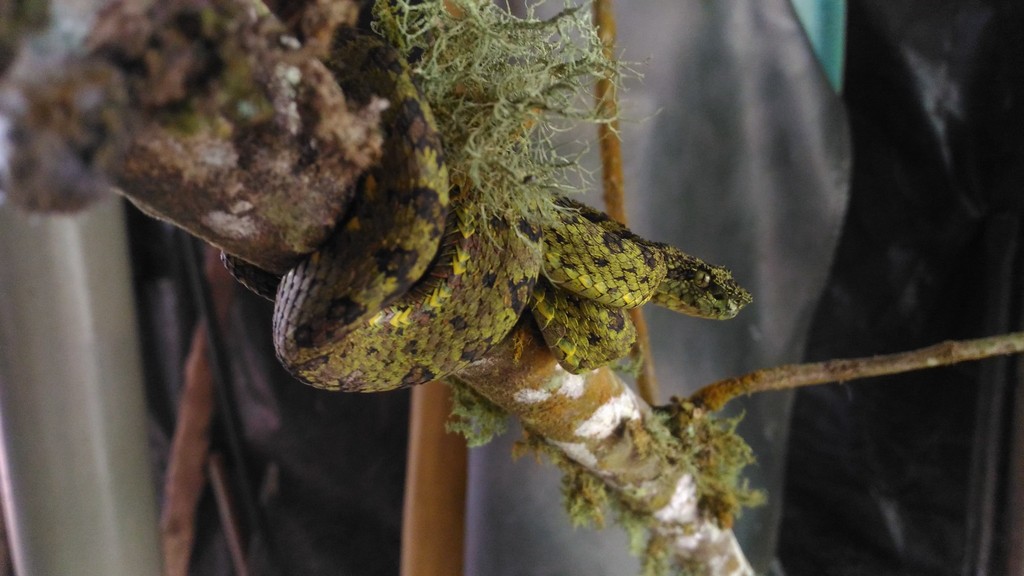


Víbora de pestañas de Khwarg
Bothriechis khwargi Arteaga, Pyron, Batista, Vieira, Meneses-Pelayo, Smith, Barrio-Amorós, Koch, Agne, Valencia, Bustamante & Harris, 2024
También llamadaKhwargs Lanzenotter (deu) · Khwarg’s Eyelash-Pitviper. (eng)
Bothriechis khwargi, also known as Khwarg’s eyelash-pitviper, is a species of pit viper in the family Viperidae. It was described in 2024, alongside 4 other species in its genus, by the Ecuadorian-Venezuelan herpetologist Alejandro Arteaga and his colleagues. It is named after Juewon Khwarg to honor his work discovering and protecting new species of vipers in the Colombian Andes. Female Khwarg’s eyelash-pitvipers can reach lengths of 610 mm (24 in), while males are shorter, reaching a maximum length of 219 mm (8.6 in).
Khwarg’s eyelash-pitviper is known from the western foothills of Colombia’s Cordillera Oriental. The species occurs over an area of approximately 14,697 km2 and has been recorded at elevations of 167–1,800 m (548–5,906 ft) above sea level. It is an arboreal snake that inhabits evergreen foothill forests, where it can be observed on the ground and in low understory vegetation. The study describing Khwarg’s eyelash-pitviper recommended it be classified as being vulnerable on the IUCN Red List because of the species' restricted range, fragmented distribution, and ongoing habitat degradation in its range. Although the species occurs in Yariguíes National Park and a private protected area, most localities where the species has been recorded are in heavily human-modified areas. An estimated 79% of the species' potential range has been deforested for agriculture.
- Registrada en
- Colombia (Cordillera Oriental)
De Wikipedia (CC BY-SA), citada sección por sección
Descripción
Female Khwarg’s eyelash-pitvipers can reach lengths of 610 mm (24 in), while males are shorter, reaching a maximum length of 219 mm (8.6 in). Khwarg’s eyelash-pitvipers have two triangular and moderately raised supraciliary scales, keeled anterior dorsal head scales, and gular scales that are much smaller than their chin shields. There are 7–14 interoculolabial scales, 3–4 canthal scales, some of which have raised triangular projections, and the loreal scale touches the preocular scale in approximately one-third of specimens. There are 21–23 dorsal scale rows at mid-body, and 144–153 rows of ventral scales in males and 145–154 rows in females. There is no yellow morph of the species. The dorsal bands are absent, faint, or restricted to top of the dorsum in juveniles, and opposing kidney-shaped dorsal marks are entirely absent in the species. There are no black speckles on the dorsal scales or ventral surfaces, with the ventral surfaces being entirely white in most individuals. The iris is pale green or straw yellow. Khwarg’s eyelash-pitviper differs from all other species in its genus by having two triangular and moderately raised supraciliary scales, keeled anterior head scales, gular scales that are much smaller than the chin shields, an entirely pale white belly in most individuals, and faint or absent dorsal bands. Khwarg’s eyelash-pitviper resembles B. …
Distribución y hábitat
Khwarg’s eyelash-pitviper is known from the western foothills of Colombia’s Cordillera Oriental. The species occurs over an area of approximately 14,697 km2 and has been recorded at elevations of 167–1,800 m (548–5,906 ft) above sea level. It is an arboreal snake that inhabits evergreen foothill forests. They can be seen both during the night and the day at ground level or on low understory vegetation. One individual was observed at night foraging in a fern one meter above the ground.
Dónde se ha registrado
Avistamientos registrados
—
registros georreferenciados en GBIF, de museos, herbarios y observadores de campo.
Arrastra el globo para girarlo. Los puntos marcan dónde hay registros, no un mapa de distribución; más oscuro significa más registros.
En los depósitos
Buscando en los depósitos…
Todas las páginas que nombran Bothriechis khwargi en la Biodiversity Heritage Library →
Referencias
- Bernal, R. (2025). Serpientes de Colombia-Guía de Campo. Serie de Guías Tropicales de Campo. 19: 396 Pp. Conservación Internacional Colombia, Bogotá.
- Reyes-Velasco, J. (2024). A revision of recent taxonomic changes to the eyelash palm pitviper, Bothriechis schlegelii (Serpentes, Viperidae). Herpetozoa, 37: 305-318.
- Arteaga A, Pyron RA, Batista A, Vieira J, Meneses Pelayo E, Smith EN, Barrio Amorós CL, Koch C, Agne S, Valencia JH, Bustamante L, & Harris KJ. (2024). Systematic revision of the Eyelash Palm-Pitviper Bothriechis schlegelii (Serpentes, Viperidae), with the description of five new species and revalidation of three. Evolutionary Systematics 8(1): 15-64.
Del Catalogue of Life (catalogueoflife.org), compilado a partir de sus bases de datos especializadas; CC BY 4.0. Este nombre en el Catalogue of Life.