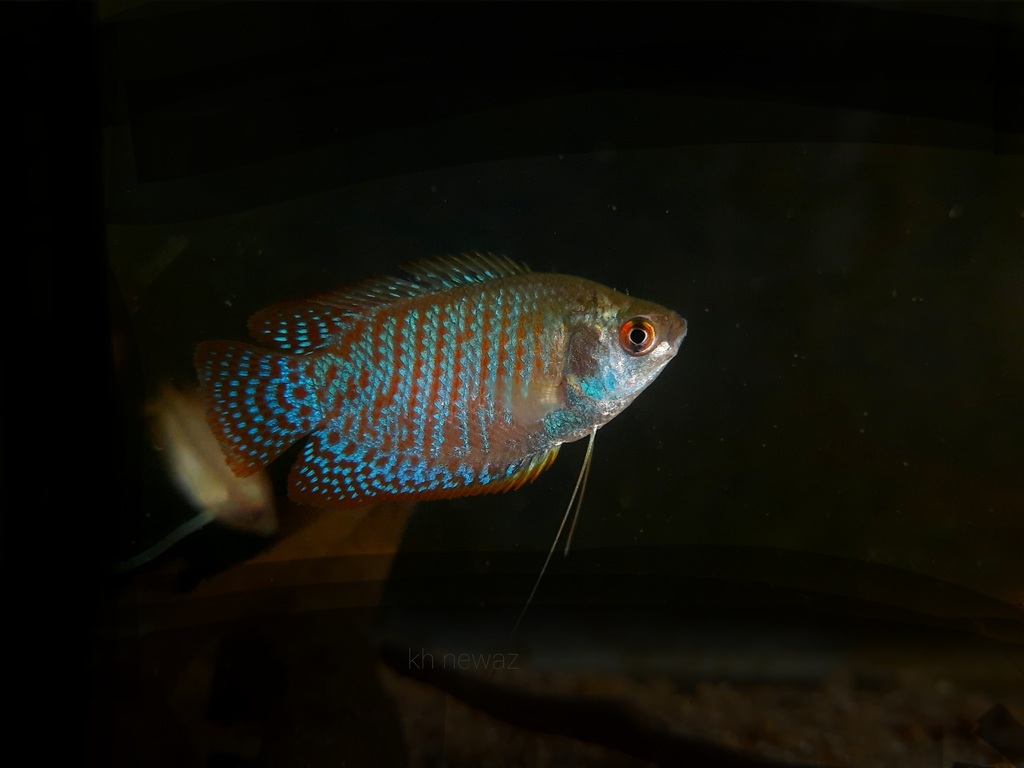


Trichogaster fasciata
Trichogaster fasciata Bloch & Schneider, 1801
Trichogaster fasciata, the banded gourami or striped gourami or Colisa or Kholshe, is a tropical labyrinth perch found in some Asian countries, including Bangladesh, Eastern India, Northeastern India, Nepal, Upper Myanmar, China and Pakistan.
It is also called the giant gourami, and for this reason it is often confused with the Osphronemus goramy, which has the same common name.
- También publicada como
- Colisa fasciata (Bloch & Schneider, 1801); Colisa fasciatus (Bloch & Schneider, 1801); Colisa ponticeriana Valenciennes, 1831; Colisa vulgaris Cuvier, 1831; Colisha fasciatus (Bloch & Schneider, 1801); Polyacanthus fasciatus (Bloch & Schneider, 1801); Trichogaster fasciatus Bloch & Schneider, 1801; Trichopodus bejeus Hamilton, 1822; Trichopodus colisa Hamilton, 1822; Trichopodus cotra Hamilton, 1822
De Wikipedia (CC BY-SA), citada sección por sección
Descripción
Trichogaster fasciata is an air-breathing fish, so the aerial respiration is performed with the help of a pair of supra-branchial chambers, each containing a complicated labyrinthine organ. The body is elongated and compressed. The mouth is small and slightly protrusible. Preorbital serrate is found in young fish. The body color is greenish, with oblique orange or bluish bars descending downwards and backwards from the back to the anal fin. It is benthopelagic, and prefers weedy environments such as estuaries, ponds, large rivers, ditches, lakes and rice fields. The species has drawn attention for its taste, nutrition and ornamental value as an aquarium fish. It is somewhat shy but quite hardy, and easily adapts to life in a community aquarium. It is also easy to breed in captivity. The banded gourami is exported to Germany, Hong Kong, Japan, Malaysia, Republic of Korea, Singapore, Taiwan, Thailand and the US due to its distinctive color. In the past, the species was readily available in freshwater pools, ponds, ditches, marshes, rivers, and lakes with vegetation, but the natural resources of this fish are declining fast due to various anthropogenic stressors.
Lo que hace
The mouth of this species is bordered by thick lips, the upper being protrudable and more pronounced in the male. Small and feeble teeth are present in the mouth and buccal cavity. The intestine is long and coiled. The fish is omnivorous in nature, so they can feed on live, frozen and flake feeds.
Dónde se ha registrado
Avistamientos registrados
—
registros georreferenciados en GBIF, de museos, herbarios y observadores de campo.
Arrastra el globo para girarlo. Los puntos marcan dónde hay registros, no un mapa de distribución; más oscuro significa más registros.
En los depósitos
Buscando en los depósitos…
Todas las páginas que nombran Trichogaster fasciata en la Biodiversity Heritage Library →
Referencias
- Cuvier, G., & Valenciennes, A. (1831). Histoire naturelle des poissons. Tome septième. Livre septième. Des Squamipennes. Livre huitième. Des poissons à pharyngiens labyrinthiformes. F. G. Levrault, Paris, v. 7: i–xxix + 1–531, Pls. 170–208. [Cuvier authored pp. 1–440, Valenciennes 441–531. i–xxii + 1–399 in Strasbourg edition.].
- Bloch, M. E., & Schneider, J. G. (1801). M.E. Blochii, Systema Ichthyologiae iconibus cx illustratum. Post obitum auctoris opus inchoatum absolvit, correxit, interpolavit Jo. Gottlob Schneider, Saxo. Berolini. Sumtibus Auctoris Impressum et Bibliopolio Sanderiano Commissum, Pp i–lx + 1–584, Pls. 1–110. https://doi.org/10.5962/bhl.title.5750
- Hamilton, F. (1822). An account of the fishes found in the river Ganges and its branches. Edinburgh & London, i–vii + 1–405, Pls. 1–39. [Often seen as Hamilton–Buchanan or Buchanan–Hamilton; in work as Hamilton [formerly Buchanan].]. https://doi.org/10.5962/bhl.title.6897
Del Catalogue of Life (catalogueoflife.org), compilado a partir de sus bases de datos especializadas; CC BY 4.0. Este nombre en el Catalogue of Life.